


Decentralized Shared Advising Structure
Decentralized Shared Advising Structure
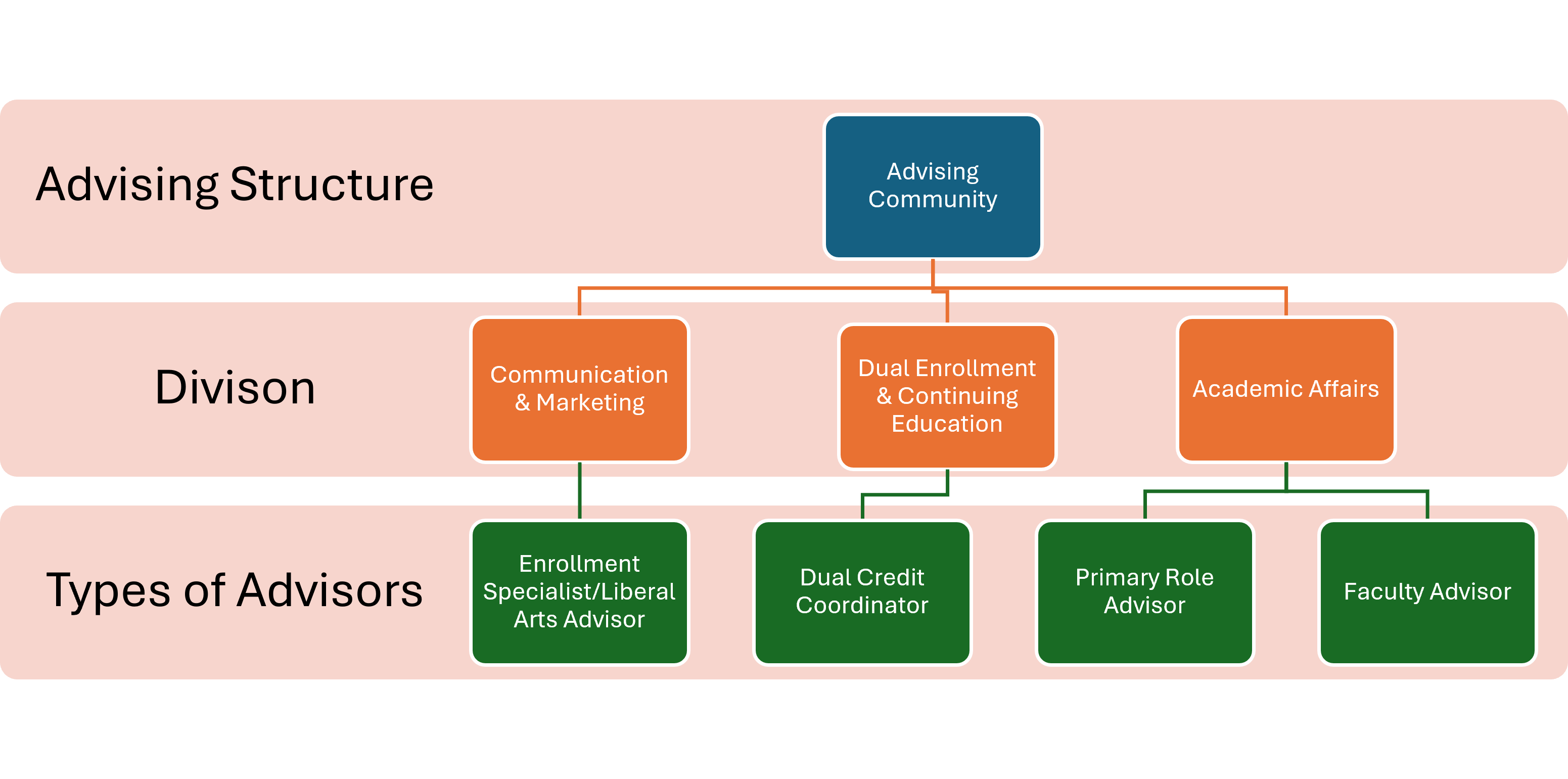
- Advising Community
- Communication & Marketing
- Enrollment Specialist/Liberal Arts Advisor
- Dual Enrollment & Continuing Education
- Dual Credit Coordinator
- Academic Affairs
- Primary Role Advisor
- Faculty Advisor
- Communication & Marketing
Download Blended Advising Model (PDF)
Definition
Decentralized Structure
By far the more prevalent decentralized structure is the Faculty Only Model where all students are assigned to a department advisor, usually a professor from the student's academic discipline. Used at 28% of all institutions, it is the model of choice at private institutions. It is found at 36% of the private 2-year colleges and 39% of the private 4-year colleges and universities. However, when considering the two most popular shared models together, 4-year private institutions using the Supplementary or Split Models (see below) slightly outnumber (at 43%) the 4-year private institutions with the Faculty Only Model (39%).
Shared Structure
The most common shared structures are the Supplementary and Split Models. In the Supplementary Model, found at 17% of all institutions, students are assigned to a department advisor. There is a central administrative unit with professional staff to support the department advisors (usually faculty) by providing resources and training. The center might serve students when they need transfer course evaluation or a degree audit. The Supplementary is the second most popular model at both 2-year private colleges (21%) and 4-year private institutions (26%).
Pardee, C. F. (2004).Organizational structures for advising. Retrieved from the NACADA Clearinghouse of Academic Advising Resources - web site: https://nacada.ksu.edu/Resources/Clearinghouse/View-Articles/Organizational-Models-for-Advising
Page last updated July 31, 2026.