



The MLT Student Handbook is designed to introduce and list the policies of the Medical Laboratory Technology Program to MLT students. These policies and procedures are not intended to supplant the policies of Del Mar College or the clinical affiliates. The handbook should assist the student in answering many of the common questions and problems he / she encounters. The handbook is not exhaustive, thus, as needed, additions and deletions will be made.
Student Handbook
MLT Student Handbook
The Medical Laboratory Technology (MLT) Student Handbook provides important information regarding the policies, procedures, academic expectations, and professional standards of the MLT Program at Del Mar College. Students are responsible for reading, understanding, and adhering to the requirements outlined in this handbook. Please be aware that MLT Program requirements may exceed those established by the College due to the specialized nature of the medical laboratory profession and the standards required for clinical education and accreditation.
Students admitted to the MLT Program will receive digital access to the Student Handbook and will be required to review its contents and electronically sign an acknowledgment confirming that they have read, understand, and agree to abide by the policies and procedures outlined within it.
The MLT Program reserves the right to revise, update, or modify handbook policies and requirements as necessary. Students are responsible for remaining informed of any changes communicated throughout their enrollment in the program.
-
Section I - Purpose
-
Section II - Mission Statement
- The Mission of the Del Mar College Medical Laboratory Technology program is to train students in entry level employment skills for clinical laboratories. Training includes instruction in fundamental concepts, hands-on laboratory skills, supervised instruction in healthcare facilities, professionalism and educational advancement as they apply to careers in clinical laboratory science.
- To educate Medical Laboratory Technicians in accordance with the standards of the National Accrediting Agency for Clinical Laboratory Sciences (NAACLS), 5600 N. River Road, Suite 720, Rosemont, IL 60018-5119, (773-714-8880).
-
Section III - The Student
3.0 Advanced Placement, Transfer of Credits for Experiential Learning
Advance placement and credit for experiential learning is not an option for the AAS degree. All courses or their equivalents must be completed. Specific life experience and professional experienced students are welcome to challenge a class and take the Final Exam at the MLT Program Director’s discretion. Experience will be evaluated on a case-by-case basis.
3.1 Student Conduct
Students will conduct themselves in a respectful, responsible and professional manner at all times in their capacity as a Del Mar College Medical Laboratory Technology student.
Conduct which casts serious doubt on the ability of a student to fulfill the role of a professional in the Medical Laboratory Technology Program will subject the student to disciplinary action under policies established in the College catalog.
3.2 Grievance, Complaints and Appeals Procedures
The Medical Laboratory Technology program will endeavor to provide each student with a complete and relevant education. In obtaining this goal, the student should utilize instructors and other resources to resolve any problem encountered in Medical Laboratory Technology classes and other academic courses. The MLT faculty take any student's grievance or complaint seriously. A student with a grievance or complaint while in the program should follow the MLT appeals process by following the department organizational chart which begins with the faculty member followed by the director of the program. If the grievance is in clinical it begins with the clinical instructor, followed by the clinical coordinator/didactic instructor and ends with the program director. If the grievance or complaint cannot be resolved within the department, the student should seek resolution through the College's administrative chain of command.
Students are encouraged to resolve concerns at the lowest level possible. The student should first discuss the grievance or complaint directly with the course instructor involved. Many issues can be resolved through open communication between the student and instructor.
If the issue cannot be resolved with the course instructor, the student should submit a formal written appeal to the Medical Laboratory Technology (MLT) Program Director, Leonor Crumley, at 361-698-2825.
Should the matter remain unresolved after review by the Program Director, the student may appeal to the Allied Health Department Chairperson, Warren Glenn Madden, at 361-698-2824.
If resolution is still not achieved, the student may continue the appeal process through the College's administrative chain by contacting the Dean of the Division of Business, Entrepreneurship, and Health Sciences, Dr. Jennifer Sramek, at 361-698-1700.
Subsequent appeals may be directed to the Vice President and Chief Academic Officer, Dr. Jonda Halcomb, at 361-698-1205, and finally to the President and Chief Executive Officer, Dr. Mark Escamilla, at 361-698-1203.
Students should follow each step of the grievance process in sequence and provide all relevant documentation supporting their appeal.
3.3 Advising
Every student enrolled in the MLT program will meet with an MLT faculty member at least once each semester to evaluate the student’s progress and provide advice towards successful completion of the program. MLT faculty will advise and guide students through the program while maintaining confidentiality and impartiality.
Students will be advised that the granting of the degree is not contingent upon passing an external certification exam.
-
Section IV - Grading
4.0 The grade scale for the Medical Laboratory Technology program is as follows:
A = 90 - 100%
B = 83 - 89%
C = 75 - 82%
D = 70 - 74%
F = <70% -
Section V - Attendance and Tardiness
5.0 The student should endeavor to attend all assigned classes and to be present on time.
5.1 A student who accumulates three (3) unexcused absences during a semester may be recommended for program probation and is subject to being dropped from the course for excessive absences or lack of progress.
5.2 A student is considered late when arriving 15 minutes after the start of class. Four tardies will constitute an absence.
5.3 In the event a student is absent for an Exam, a make-up Exam will be given only with the Instructor’s permission or for illness (Dr.’s excuse required).
5.4 If a student is on probation due to absences and misses classes after the last day to drop a class, he / she will not be allowed to turn in any assigned work or to take the final exam.
5.5 Clinical Attendance and Tardiness
Students are responsible for notifying the clinical affiliate and the Del Mar College clinical instructor prior to their reporting time if they will be late or absent. Missed clinical time is expected to be made-up by the student with the consent of the clinical site. The student is responsible for arranging make-up time with the clinical site.
It is mandatory for the student to be at the clinical affiliate at the assigned times. The following criteria will be applied to attendance:
Absent without make-up: % missed days from Affective Grade
Absent without notifying clinical: - 20 pts. from Affective Grade
Leaving clinical early without permission: - 20 pts. from Affective Grade
-
Section VI - Probation and Dismissal of a Student from the MLT Program
6.0 A student may be placed on Probation for one or more of the following reasons:
- Excessive tardiness and / or absences.
- A grade of “D” or “F” in one (1) or more MLT courses.
- A Grade Point Average less than 2.0.
- Unethical or unprofessional conduct in the classroom or clinical affiliate which violates Del Mar College or clinical affiliate policy or jeopardizes student safety or patient care.
- Failure of a student to notify a clinical affiliate and MLT faculty of an absence prior to the assigned training time.
6.1 A student may be dismissed from the program for one or more of the following reasons:
- Excessive tardiness and / or absences.
- A grade of “D” or “F” in two (2) or more MLT courses.
- A Grade Point Average less than 2.0.
- Unethical or unprofessional conduct in the classroom or clinical site which violates Del Mar College or clinical site policy or jeopardizes student safety or patient care.
-
Section VII - Clinical Dress Code
7.0 All students are expected to keep themselves neat, clean, and well groomed at all times. This is to include physical appearance for clinical training and classroom instruction.
The following specific regulations are to be observed:
7.1 Dress: Clinical site approved “scrubs” or professional attire may be worn. Blue jeans, miniskirts, shorts, and knee-length pants are not acceptable. (Blue jeans are acceptable for classroom instruction.)
7.2 Cosmetics: Application of cosmetics in the work area is prohibited.
7.3 Hair: Long hair should be tied back to prevent it from falling forward while performing laboratory work.
7.4 Jewelry: Wearing excessive jewelry is not allowed.
7.5 Shoes: Footwear must completely cover feet.
7.6 Facial Hair: Must comply with clinical site regulations.
7.7 Name Badges: Each student shall wear a name badge during clinical rotation. The badge shall contain the following information:
Del Mar College, Student Name, Student MLT.
7.8 Excessive use of perfumes or colognes is prohibited.
7.9 Clinical site policies may supersede these regulations.
-
Section VIII - Clinical Conduct
8.0 While in clinical setting, the student is responsible to the personnel policies and procedures of the institution.
8.1 While in clinical setting, the student is responsible to the clinical supervisor / instructor to whom they are assigned.
8.2 While in the clinical setting the student shall:
- Respond positively to physicians, personnel, patients, and instructor. The student must keep in mind that clinical faculty have their primary responsibility in patient care.
- Accept and respond constructively to constructive criticism.
- Follow clinical protocol when dealing with clinical problems.
- Accomplish all assigned tasks or take steps to ensure that they are accomplished.
- Follow defined hospital policies and procedures.
- Conduct themselves in accordance with professional ethics and patient rights.
- Perform only those procedures that he/she has been authorized to perform.
- Maintain the confidentiality of the patient.
8.3 The student will notify the clinical site and Del Mar College clinical instructor prior to the assigned time if late or absent.
8.4 The student will maintain an accurate record of their clinical attendance.
8.5 Clinical assignments may be changed at the discretion of the Clinical Supervisor or Instructor of the Medical Laboratory Technology program.
8.6 The student must obtain permission from a clinical instructor to go on a break or lunch.
8.7 After consultation with the MLT Program Director, a student may be dismissed from the clinical for the following reasons:
- Failure to comply with the Dress Code
- Irresponsible or unethical conduct.
- Performance of unauthorized procedures.
- Falsification of clinical records.
- Negligence in the performance of patient care procedures.
- Failure to keep their immediate clinical supervisor informed of their location.
- Failure to comply with the guidelines addressed under clinical conduct.
- Failure to notify affiliate of absence prior to the assigned training time. A student may be readmitted to the clinical only after counseling and consent of the clinical site.
8.8 The use personal electronic devices is prohibited during clinical training.
-
Section IX - Service Work
9.0 Students may not be scheduled as substitutes or work as replacements for regularly scheduled hospital personnel. Students are approved to work for the clinical site outside of normally scheduled educational periods.
-
Section X - Medical Laboratory Technology Program Career Entry Competencies
Upon successful completion of all components of the MLT Program the student shall be proficient in the following:
10.0 Collecting and processing biological specimens and products for analysis.
10.1 Performing analytical tests on body fluids, cells, and products.
10.2 Recognizing factors that affect procedures and results, and taking appropriate actions within predetermined limits when corrections are indicated.
10.3 Performing and monitoring quality control within predetermined limits.
10.4 Performing preventive and corrective maintenance of equipment and instruments or referring to appropriate sources for repairs.
10.5 Demonstrating professional conduct and interpersonal communication skills with patients, laboratory personnel, other health care professionals, and the public.
10.6 Applying principles of safety.
10.7 Recognizing the responsibilities of other laboratory and health care personnel and interacting with them with respect for their jobs and patient care.
10.8 Applying basic scientific principles in learning new techniques and procedures.
10.9 Relating laboratory findings to common disease processes.
10.10 Recognizing and acting upon individual needs for continuing education as a function of growth and maintenance of professional competence.
Upon graduation and initial employment, the medical laboratory technician should be able to demonstrate entry level competencies in the above areas of professional practice.
-
Section XI - Policy for Determining Clinical Assignments
If the number of available assignment positions is less than the number of students eligible for clinical rotation, the following rules will be applied for the determination of clinical assignments.
11.0 Those students who have the highest numerical grade in the course preparing them for a clinical rotation will be assigned to a clinical affiliate. Students who cannot be assigned will be ranked by their numerical MLT course grade and assigned when space is available at the next possible rotation assignment period.
11.1 In the event that more than one student attains the same numerical grade, and a decision must be made as to who shall be assigned, the following criteria shall be applied:
- The student’s overall MLT course work numerical average.
- If a tie still remains, then:
- The student’s overall Del Mar College Grade Point Average (GPA).
- The student’s overall MLT course work numerical average.
-
Section XII - MLT Program Statement of Non-Discrimination
12.0 Pursuant to Section 504 of the Rehabilitation Act of 1973, Del Mar College will provide services and training, without discrimination, to any qualified handicapped person who meets the academic and technical standards requisite to admission and/or participation in the Medical Laboratory Technology Program.
-
Section XIII - Technical Standards for the Medical Laboratory Technician (MLT)
Employment Qualifiers
13.1 Students must be free from contagious diseases and chemical dependence.
13.2 Students must be able to perform all functions and tasks required of a MLT.
13.3 Students must not have been convicted of a felony.
Visual Observations
13.4 Differentiate color changes during the performance of laboratory procedures.
13.5 Observe patient’s condition during phlebotomy procedures.
13.6 Read lab instrument technical procedure manuals, standard operating procedures, patients' charts, and other pertinent materials for patient care and professional practice.
Motor Function
13.7 Perform venipuncture at patients' bedside or at other designated locations.
13.8 Lift and handle medical technology equipment and tools.
13.9 Manipulate medical laboratory instruments and equipment in a manner consistent with standards of medical laboratory practice.
Communication Skills
13.10 The student shall possess verbal and non-verbal skills adequate for transmitting information to patients and others.
13.11 Adequate hearing for communication skills with both hospital personnel and patients.
Behavioral and Social Skills
13.12 Student behavioral and social skills must be acceptable in both college and hospital settings.
-
Section XIV - Patient Confidentiality and Medical Records Guidelines
14.1 MLT students are required to obey the Health Insurance Portability and Accountability Act of 1996 (HIPAA) regulations.
14.2 HIPAA creates standards that address the use and disclosure of individuals’ health information, called "protected health information," by organizations subject to the Privacy Rule, known as "covered entities," as well as standards for individuals' privacy rights to understand and control how their health information is used.
14.3 Violation of these regulations could result in the student's dismissal from clinical training and dismissal from the MLT program.
-
Section XV - Required Drug Testing and Criminal Background Screening
15.0 Criminal background checks and Drug Testing have been introduced into hospital and school affiliation agreements in keeping with a Joint Commission on Accreditation of Health Care Organizations (JCAHO) standard. Individual institutions have been given the responsibility for mandating this clearance for students. These facilities require drug testing and criminal background checking of each student, prior to the time the student would have contact with the facility's patients or employees. Before an MLT student can be placed at a clinical facility for their clinical experience, the student must have certain acceptable results on both a drug test and a criminal background checking.
Therefore, in keeping with this policy, all MLT students will be required to undergo a background check for security clearance and drug testing for continued enrollment in the MLT program.
15.1 Selection of company to perform drug testing and criminal background check.
The Allied Health Department will notify students of the company designated to perform the drug testing and criminal background check. The department will not accept drug test and criminal background check results from any company other than the one designated by the Allied Health Department. For example, the program will not accept a drug test/criminal background check which a student has independently obtained from the company outside the procedure provided in this policy.
The company selected is independent and separate from Del Mar College. It is not and shall not be considered a partner, joint venturer, employee, or agent of Del Mar College.
At the time of the drug testing / criminal background check, the student is required to pay the cost. The cost of the criminal background check and the drug testing is the student's responsibility for a grand total of approximately $120.00.
Drug Testing
15.2 Timing of the Drug Test
MLT students enrolled in clinical course work for the first time or a student who has had a break in enrollment in clinical courses are required to complete the drug test at the time designated prior to the first clinical day in the facility no more than 30 days prior. A break in enrollment is defined as non-enrollment for one full semester, or more in clinical course work.
15.3 Drug Test Procedure/Requirements
Each student is required to sign all consents/releases, including consent to the drug test and permission for the results of the drug test to be provided to the Allied Health Department. It is a violation of this policy for a student to adulterate or attempt to adulterate a specimen, to engage in any deceptive behavior during or in connection with the testing process or take any other action which would falsify test results or tend to make test results inaccurate.
If the drug test result is positive, the student may contact the Medical Review Officer [“MRO”] affiliated with the testing company, at an additional cost to the student.
15.4 Interpretation of Drug Tests
A positive drug screen for a student is defined under this policy to be one reported as such by the testing company selected. Generally, this refers to the testing company indicating the student tested outside the acceptable range set by the testing company, and with the MRO not determining the test result should be a negative. A negative test for a student is defined under this policy a test result which is not a positive test result.
15.5 Reporting of Drug Test Results
The testing company will communicate the drug test results to the nursing program. It is the policy of Del Mar College to maintain the confidentiality of these drug test results to the extent required by law.
15.6 Consequences of Positive Drug Testing
- The student will be immediately suspended for a minimum of one year (12 continuous months from the date of the beginning of the suspension) from the program.
- The positive drug screen will be shared by the Allied Health Department with the Vice-President of Student Services for further action, including but not limited to referral for a drug abuse education program, referral to counseling, and/or referral to a drug treatment program.
- Any MLT student with a positive drug screen is encouraged to seek treatment. Del Mar College encourages impaired students to seek assistance voluntarily and assume responsibility for their personal and professional conduct.
- A student who has on one occasion had a positive drug screen under this policy, and who desires to reapply to Del Mar College, may reapply only for a school semester beginning after the period of suspension (one year minimum). The student will, in addition to meeting all other requirements for similarly situated applicants, be required to provide documentation of successful treatment and to consent to and undergo a retest through a testing company selected by Del Mar College. This re-testing is at the student's expense.
The decision on whether to re-admit to the student is not guaranteed and will be made on a case-by-case basis.
15.7 Estimated Cost of Drug Test
Approximately $60.00. The cost of the drug screen is the student's responsibility.
15.8 Suspicious Testing
Additionally, a student assigned to a facility for a clinical experience, and who is suspected by the facility or faculty of substance use or abuse, will be asked to consent to a drug test. In this situation, the student is required to sign the consent and complete an immediate drug test.
Criminal Background Check
15.9 It is intended that the background check include all cities and counties of known residence for the 7-year period prior to the check.
15.10 Criminal background Check
Under this policy, the term “failing” the criminal background check is defined as the screening company reporting to the appropriate Health Science Program office that the student had any of the following, during the 7-year period prior to the check.
- DUI
- Social Security verification
- Criminal search
- Employment verification
- Violent sexual offender and predator registry search
- Education verification
15.11 Reporting of Criminal Background Check
The company conducting the criminal background check will communicate the criminal background check results to the Director of Nursing Program. It is the policy of Del Mar College and the nursing department to maintain the confidentiality of these criminal background check results to the extent required by law.
15.12 Consequences of a failed criminal background check
- The student will be immediately suspended from the MLT program, unless the company conducting the check reports to the MLT program, perhaps through clarifying information provided by the student to the company that the student no longer fails the check.
- The student will be notified of a description of the adverse action taken, the name of the company which prepared the report, a statement that the company did not make the decision to take the adverse action, that the student has a right to obtain a free copy of the company's report from the company, and to contest its contents.
- A student who is convicted of or receives deferred adjudication for any of the criminal offenses referred to above while enrolled in the program must report the conviction to the Allied Health Department, within three days of the conviction, and the student will be referred to the Vice-President of Student Services and suspended from the MLT program.
15.13 Estimated Cost of the Criminal Background Check
Approximately $61.32. The cost of the criminal background check is the student's responsibility.
-
Section XVI - Assumption of Risk and Consent to Procedures
During this program you will be participating in laboratory activities which requires the use of human subjects and body fluids.
It is important that you be aware that blood and other body fluids have been implicated in the transmission of pathogens including Hepatitis B Virus (HBV) and Human Immunodeficiency Virus (HIV). To minimize risk of exposure to bloodborne pathogens, students must agree to follow Standard Precautions guidelines as well as comply with regulations outlined in the OSHA Bloodborne Pathogen Standard.
-
Section XVII - Immunizations
Department of State Health Services
Disease Prevention and Intervention Section
Immunization BranchPolicy Statement 1.0
Completion of Hepatitis B Vaccine series prior to direct patient careThe Texas Department of State Health Services (DSHS) rule §97.64, “Required Vaccinations for Students Enrolled in Health-Related and Veterinary Courses in Institutions of Higher Education” [25TAC§97.64, April 2004], requires students enrolled in health-related courses, which will involve direct patient contact in medical or dental care facilities to complete a three-dose series of hepatitis B vaccine prior to direct patient care. This rule applies to all medical interns, residents, fellows, nursing students, and others who are being trained in medical schools, hospitals, and health science centers and students attending two-year and four-year colleges whose course work involves direct patient contact regardless of the number of courses taken, number of hours taken, and the classification of the student.
The DSHS Rule on “Required Vaccinations for Students Enrolled in Health-related and Veterinary Courses in Institutions of Higher Education” is clarified as follows:
DSHS RULE and DSHS INTERPRETATION
Students may be enrolled provisionally for up to one semester or one quarter to allow students to attend classes while obtaining the required vaccines and acceptable evidence of vaccination. (§97.64(b)) Students shall receive a complete series of hepatitis B vaccine prior to the start of direct patient care or show serologic confirmation of immunity to hepatitis B virus. (97.64(I))
- Students may enroll in health-related courses in two-year and four-year colleges.
- Although the student may enroll in the school or course, completion of the hepatitis B vaccination series must be completed prior to direct patient care as defined below.
- Direct patient care is defined by DSHS, for purposes of this rule, as students whose course work involves contact with patients in a manner that can result in direct contact with blood, blood-contaminated body fluids, or other bodily fluids from the patient.
17.1 MLT students must complete and provide written documentation of the immunizations listed below prior to the beginning of hospital clinical training.
- HBV
- Rubella Titer (Vaccine if necessary)
- MMR
- Diphtheria / Tetanus
- Varicella - Zoster titer
- TB Skin Test (PPD) to be updated annually
- Influenza immunizations may be required by clinical affiliates.
-
Section XVIII - On-Line Safety Training and CPR Training
18.1 MLT students will be required to complete on-line safety training administered via Canvas prior to the beginning of hospital clinical training.
18.2 A valid CPR card must be obtained prior to the beginning of hospital clinical training.
Estimated Cost of CPR certification - Approximately $19.95. The cost of the CPR is the student's responsibility.
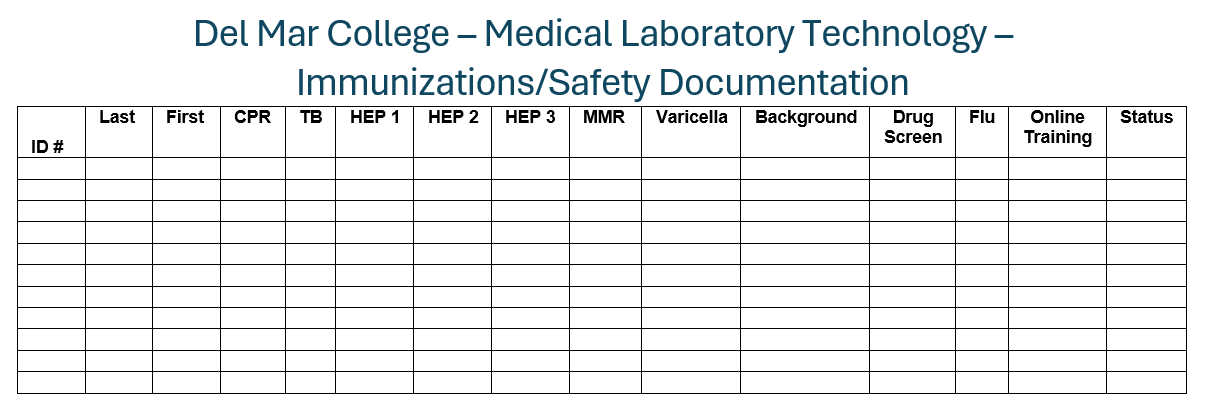
18.3 A copy of all immunizations, PPD Skin test, CPR training, Drug Screen, Background check and online safety training is to be maintained by the Department of Allied Health and MLT program.
A summary of immunization dates and expiration dates will be maintained by the Department of Allied Health and MLT program.
Example of recording keeping tool for Immunizations/Safety Documentation:
-
Section XIX - List of Clinical Affiliates
Baylor Scott and White – Marble Falls
810 W HWY 71
Marble Falls, TX 78654Citizens Medical Center
2701 Hospital Dr.
Victoria, TX 77901Christus Spohn Hospital - Alice
2500 E. Main St.
Alice, TX 78332Christus Spohn Hospital - Beeville
1500 E. Houston St.
Beeville, TX 78102Christus Spohn Hospital - Kleberg
1311 General Cavazos Blvd.
Kingsville, TX 78363Christus Spohn Regional
601 North 19th Street
Corpus Christi, TX 78408Christus Spohn Hospital - Shoreline
600 Elizabeth
Corpus Christi, TX 78404Christus Spohn Hospital - South
5950 Saratoga
Corpus Christi, TX 78414Columbus Community Hospital
110 Shult Dr.
Columbus, TX 78934DeTar Hospital Navarro
506 E. San Antonio St.
Victoria, TX 77901DeTar Hospital North
101 Medical Dr.
Victoria, TX 77904Driscoll Children’s Hospital
3533 S. Alameda
Corpus Christi, TX 78411HCA Corpus Christi Medical Center - Bay Area
7101 South Padre Island Drive
Corpus Christi, TX 78412HCA Corpus Christi Medical Center - Doctors Regional
3315 S. Alameda
Corpus Christi, TX 78411HCA Corpus Christi Medical Hospital – ER 24/7 Northwest
13725 Northwest Blvd.
Corpus Christi, TX 78410HCA Corpus Christi Medical Hospital – ER 24/7 Portland
1702 US 181 Suite A-AA
Portland, TX 78374Jackson County Hospital District
1013 South Wells Street
Edna, TX 77957Laredo Texas Hospital
1700 E. Saunders St.
Laredo, TX 78041Matagorda Regional Medical Center
104 7th Street
Bay City, TX 77414Otto Kaiser Memorial Hospital
3349 S. Hwy 181
Kenedy, TX 78119Uvalde Memorial Hospital
1025 Garn Field R.
Uvalde, TX 78801 -
Section XX - Teach Out Policy
In the event of a natural disaster, damage to the physical facilities at Del Mar College, voluntary closure of the Medical Laboratory Technology program, or other circumstances that terminates or delays classroom-laboratory instruction of the MLT curriculum, a “Teach Out” Policy establishes procedures to notify administrators, community representatives, currently enrolled and potential MLT students about the status of the program.
Currently enrolled MLT students will be advised about alternative plans that will allow them to complete their MLT degree plan.
Initial Response Plan
Step Responsibility Program Director notifies DMC administrators and begins development of a Teach Out Plan. MLT Program Director Delay or discontinue recruitment of new students. MLT faculty and DMC Admissions Office Advise current MLT students about the Teach Out Plan process. MLT faculty Arrange a meeting with DMC administrators and MLT Advisory Committee to discuss alternative instruction plans. MLT faculty, DMC administrators and Advisory Committee Secondary Response Plan
Step Responsibility Hold meeting with current MLT students to discuss the Teach Out plan. MLT Program Director Final Response Plan
Step Responsibility Publicly announce Teach Out Plan DMC administration Monitor and advise current MLT students regarding their progress within the Teach Out Plan MLT Program Director Non-renewal of faculty contracts (if required) DMC administration
Page last updated October 27, 2026.